|
Timeline of Polar products 1986 – 1996
|
|
Once in the service and repair world Polar sought further development of troubleshooting tools – had resulted in the T1000 Fault Locator and Transistor Curve Tracer, enabling technicians to compare “signatures” of good and faulty boards and components. In a counter-intuitive twist, a distributor suggested we remove the transistor test capability and a simpler product – the T1500 – brought an easier to understand tool – and sales took off.
The early days of computing brought a range of new challenges to electronics developers and service technicians. Polar’s B2000 and B3T were “microprocessor simulators” You plugged them in place of the 40-way microprocessor and could, through a simple keyboard, address memory and read and write from input and output ports – a great tool for troubleshooting and learning. One application was the service and repair of coin-in-the-slot pay telephones – remember them?
|
| 1987 |
|
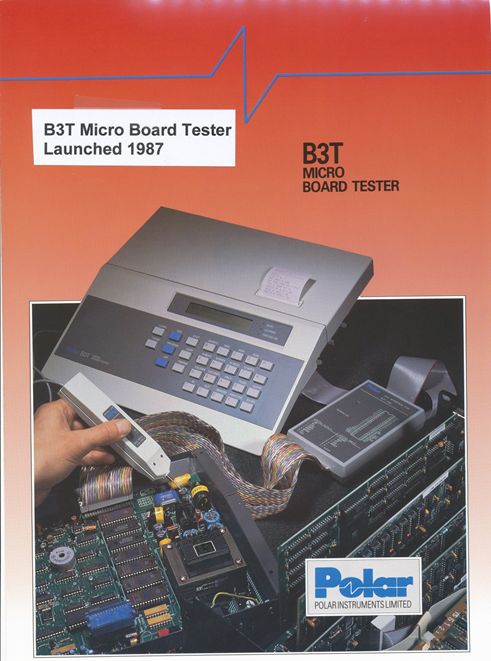
B3T Micro Board Tester
Microprocessors brought new challenges to designers debugging prototypes
and technicians diagnosing them in service. The B3T was a static microprocessor
simulator you simply plugged the 40 way connector into the processor socket and
a technician gained the powerful ability to statically address memory and I/O ports.
Powerful, but the advent of ever more complex processors meant the B3T era
ended at the 80286 simulator pod – one of our most complex designs of the era.
|
| 1988 |
|
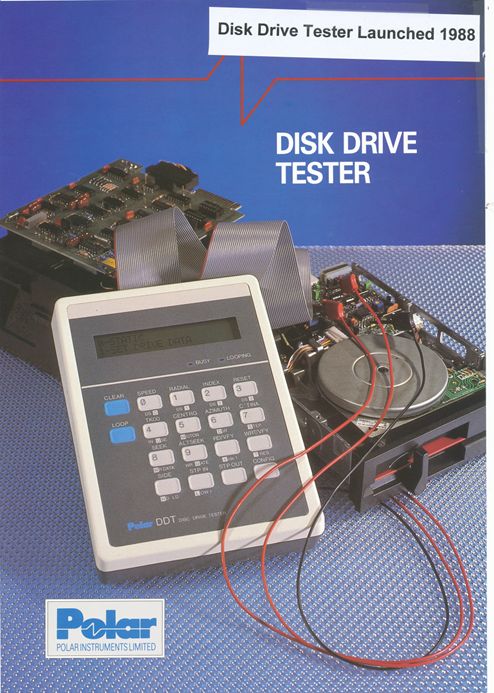
DDT Disk Drive Tester
Re-utilising some of the B3T technology, the DDT Disk Drive Tester tested and
diagnosed the ubiquitous floppy disk drives so commonplace in the 1980s
|
| 1988 |
|
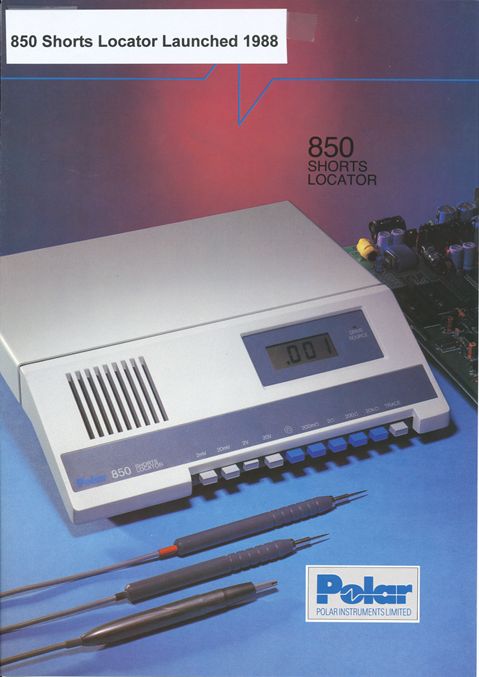
850 Shorts Locator
Restyled in the house look of the B3T, the Toneohm 850 boasted leakage test
with a uV range and drive source, along with Hall Effect current probes for
data bus fault location and the ever popular milliohm short circuit location
all with the Toneohm™ sound.
|
| 1988 |
|
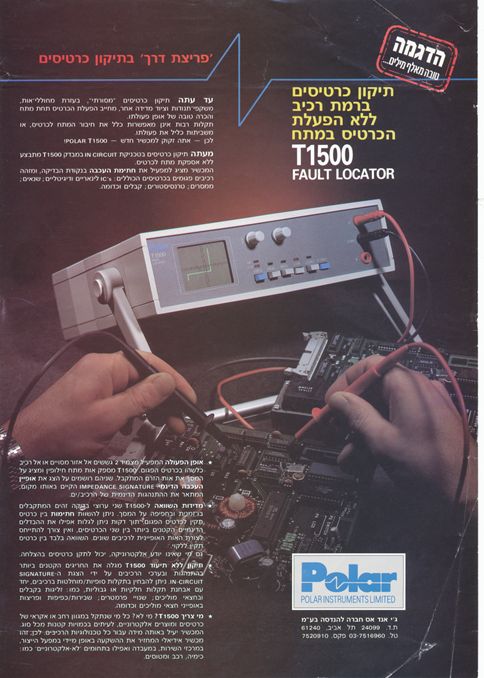
T1500 Fault Locator
Freed of its transistor curve tracer origins as a simple V/I analog signature
troublshooter with built in CRT, sales of the T1500 took off and sold to
"smokestack industries" who needed to maintain their legacy electronics.
|
| 1990 |
|
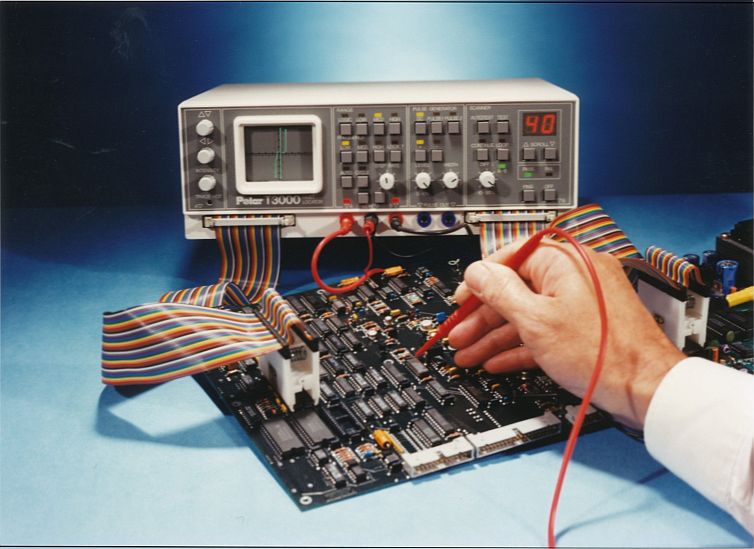
T3000 Fault Locator
Adding a 40 pin scanner to the T1500
resulted in the T3000 with
auto ASA signature comparison.
Practical and rapid
comparison
troubleshooting
when comparing known good and faulty PCBs with
high
quantities of
DIL (Dual in line)
integrated circuits. |
| 1990 |
|
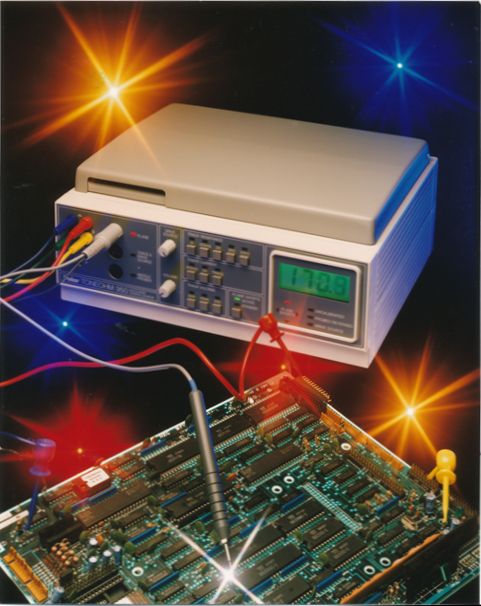
Toneohm 950 Multilayer Shorts Locator
Fulfilling customer demand for power ground plane
short circuit location - the 950 delivered the worlds first
power to ground and track to ground plane short circuit
location - with Polar's unique Vector Plane Stimulus
VPS(TM)
|
| 1991 |
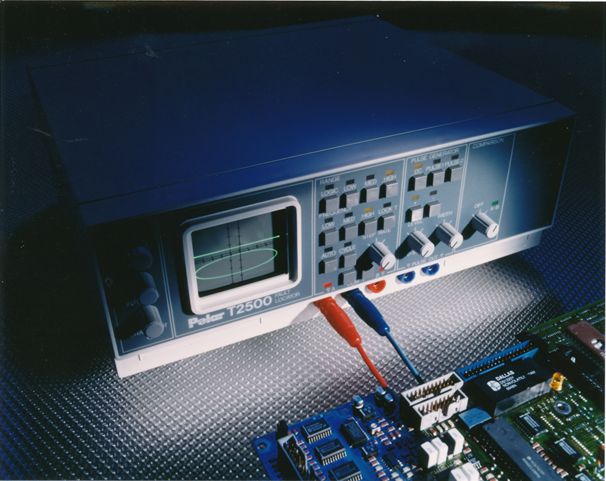
T2500 Fault Locator
Simplifying the T3000 without a scanner to lower the entry price failed to have the effect on
sales
that removing the curve tracer from the T1000 effected in earlier times.
|
| 1992 |
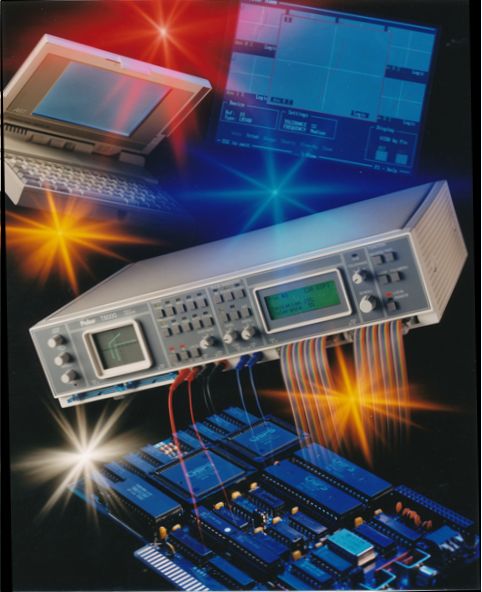
T6000 Fault Locator
The advent of low cost "IBM compatible" personal computers made digital
storage of known good boards a reality. Though capable of saving signatures
in this way, the T6000 was such a pleasure to use in stand alone mode
– many customers never used the very capable PC interface.
|
| 1993 |
|
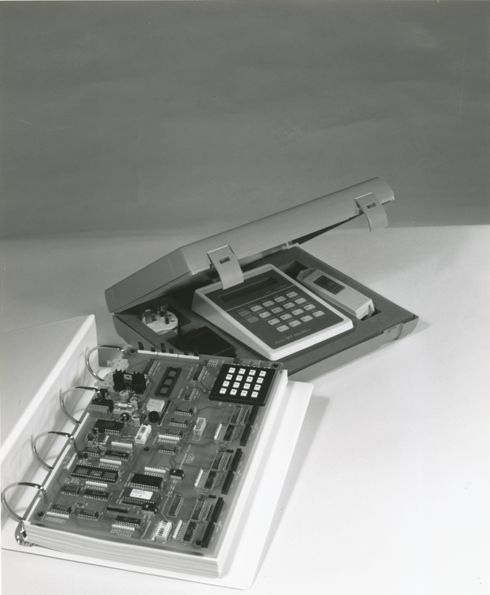
TF1000 Micro Theory and Fault-finding Training Package
With technical schools wishing to educate a new generation of electronics technicians
on microprocessors, the Z80 based TF1000 was aimed at giving students a first
principles understanding of simple microprocessors. Unfortunately, it failed to gain
traction as the management of institutions invariably wanted support for the later
processors, failing to grasp that it was a concept level educational tool.
|
| 1994 |
|
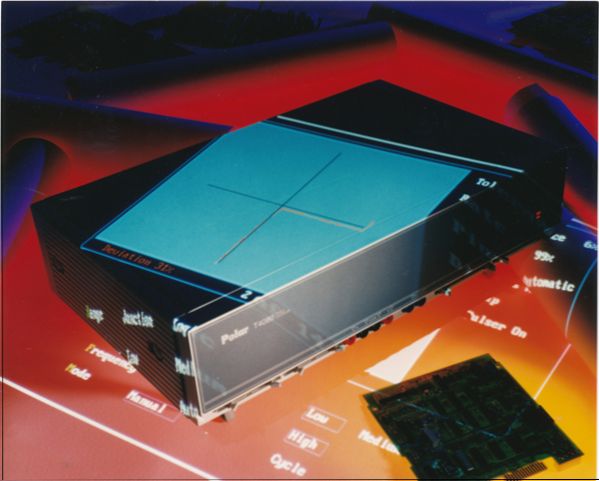
T4000 Faut Locator
Following the success of the T6000 – and with the nascent fashion for "virtual instrumentation"
the T4000 was a virtual and low cost variant of the T6000. It was perhaps before its time as the
T6000 continued to outsell, though it eventually found a niche in low volume manufacturing
defect analysis as a very economic alternative to a traditional ATE.
|
| 1994 |
|
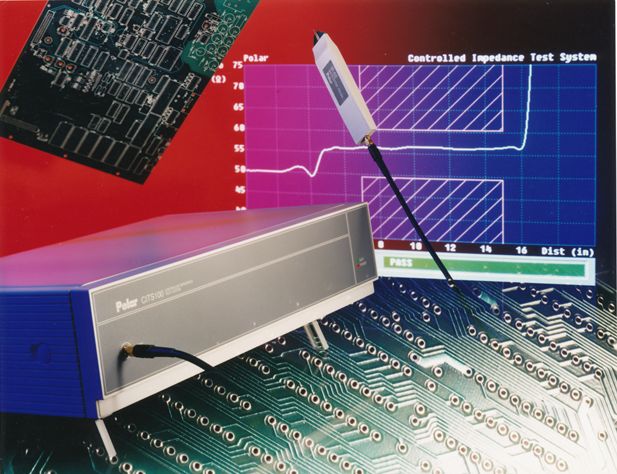
CITS100 Controlled Impedance Test System
For 21st century Polar customers, the CITS100 is the birthplace of our present era. The UK Ministry
of
Defence and Defence Research agency, along with several UK PCB fabricators, identified the
need for an easy to use production test tool for PCBs using transmission line technology (controlled
impedance), then in its infancy, but with growing demand from the military communications
and
instrumentation sector. Polar worked closely with colleagues in the PCB industry and developed
the first Polar CITS – Controlled Impedance Test System – the CITS100 for MS-DOS.
|
| 1995 |
|
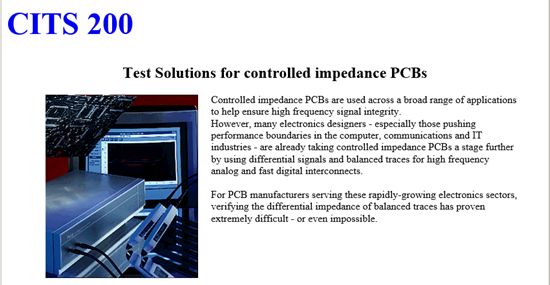
CITS200 Controlled Impedance Test System
Soon after the release of the CITS100 it became clear that the use of differential signalling
with its superior noise immunity was becoming mainstream: the CITS200 ensued, allowing
PCB fabricators to test both single ended and differential transmission lines. One of the
challenges of those early impedance measurement days was to prove that a little known
Polar product could deliver the accuracy and repeatability of the two heavyweight TDR
brands on the market. Using precision reference traceable airline standards in calibration
and at product demonstrations laid those questions to rest. Polar still employs NIST and
NPL
traceable lines for product calibration and verification.
|
|
|
